The periodic table with data you can trust.
All 118 elements and the 22 tables from the back of your chemistry textbook, plus eleven lab calculators and quizzes. Data checked against PubChem, IUPAC, NIST and the IAEA. No ads, no account, and it works offline.
For iPhone, iPad, Mac and Apple Watch · in 20 languages
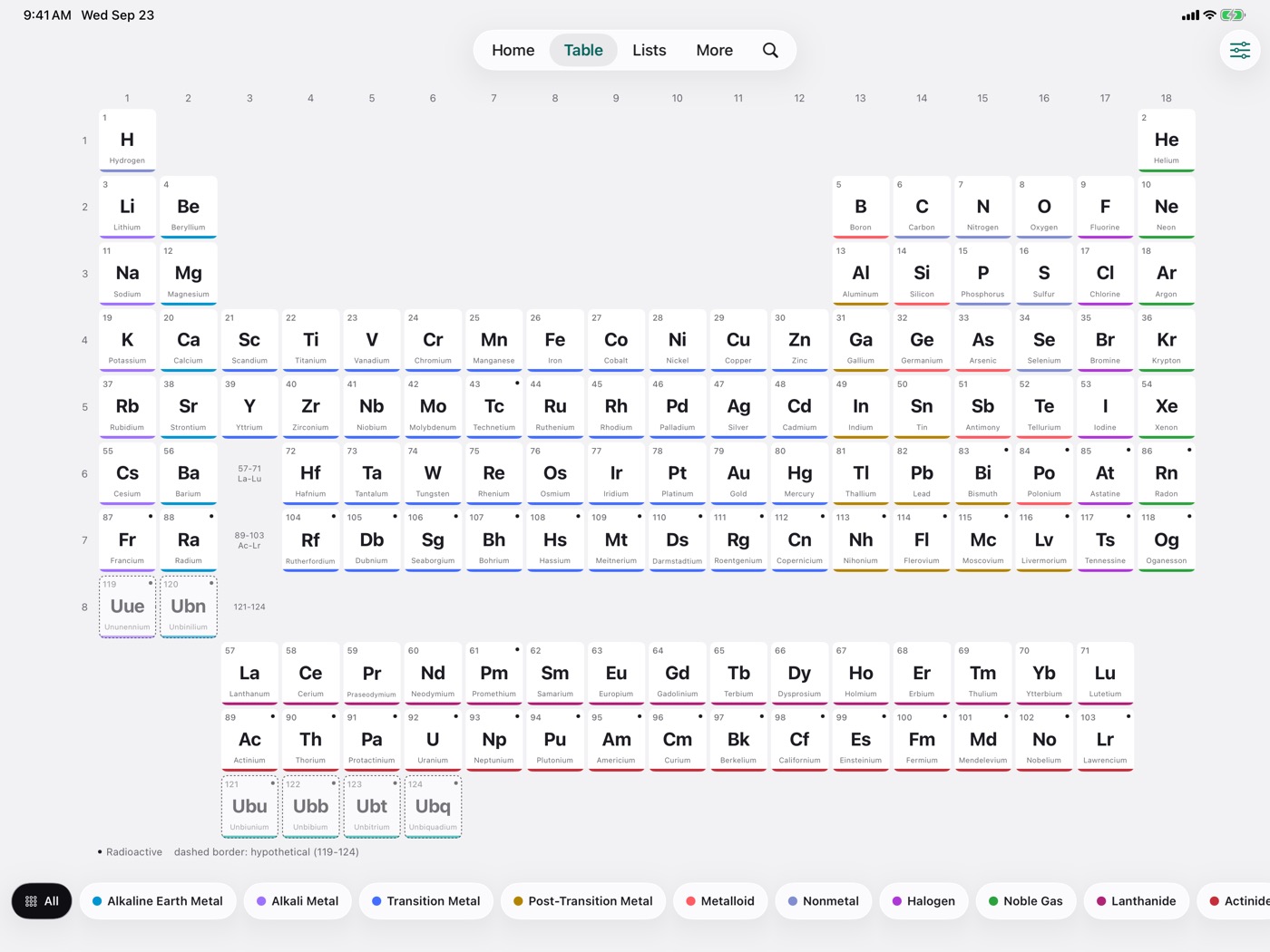
Look up, calculate, compare and practice.
Everything you need for chemistry class, in your pocket.
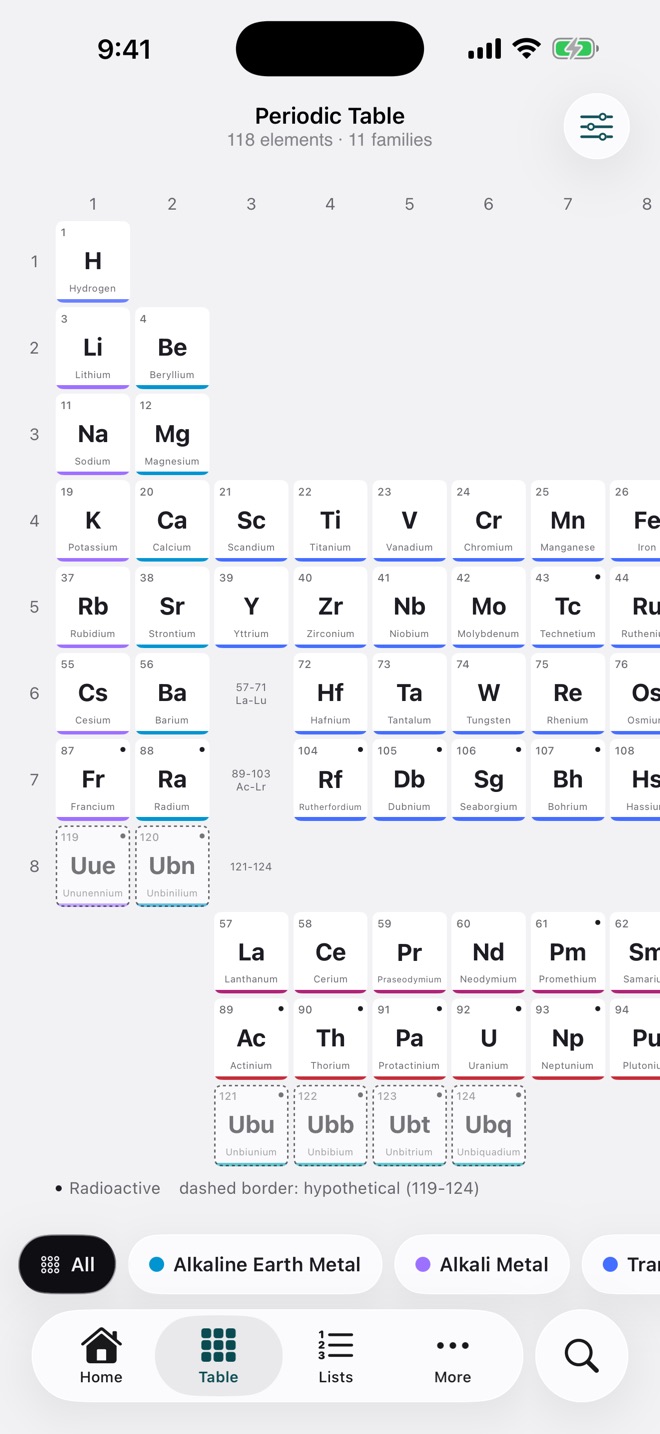
The full table
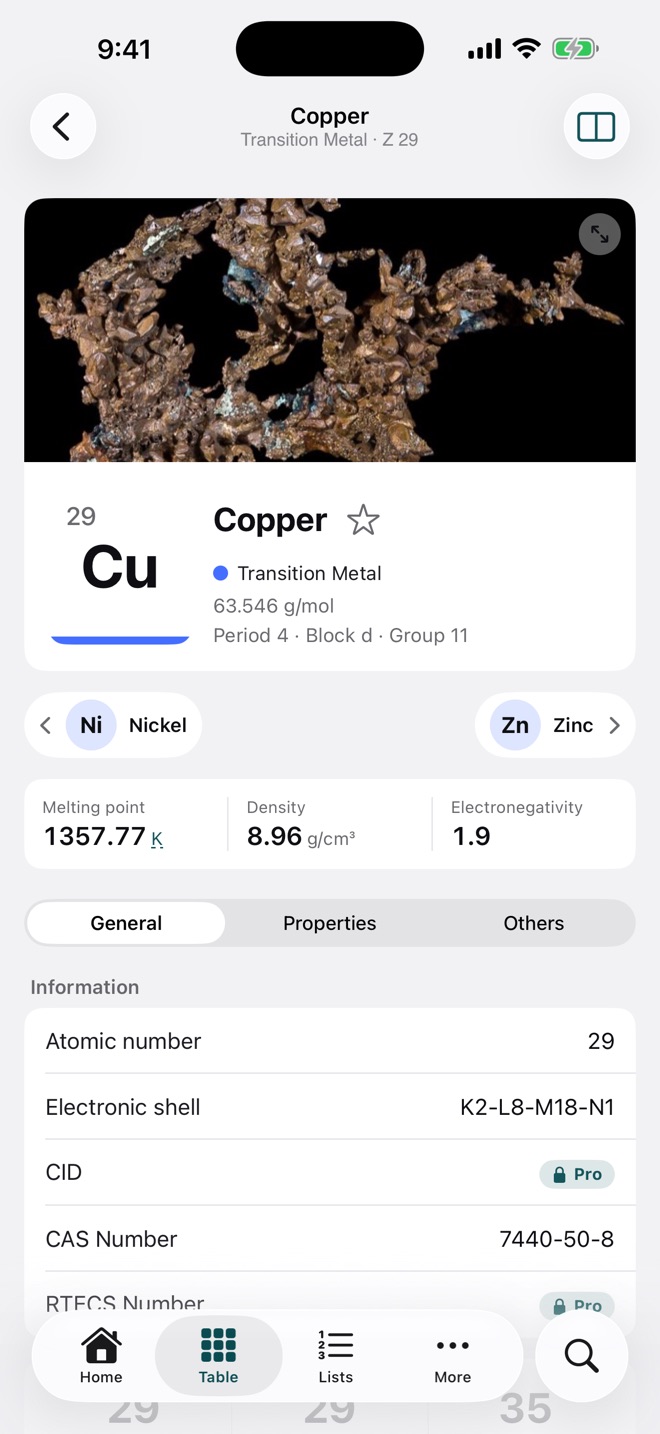
The copper page
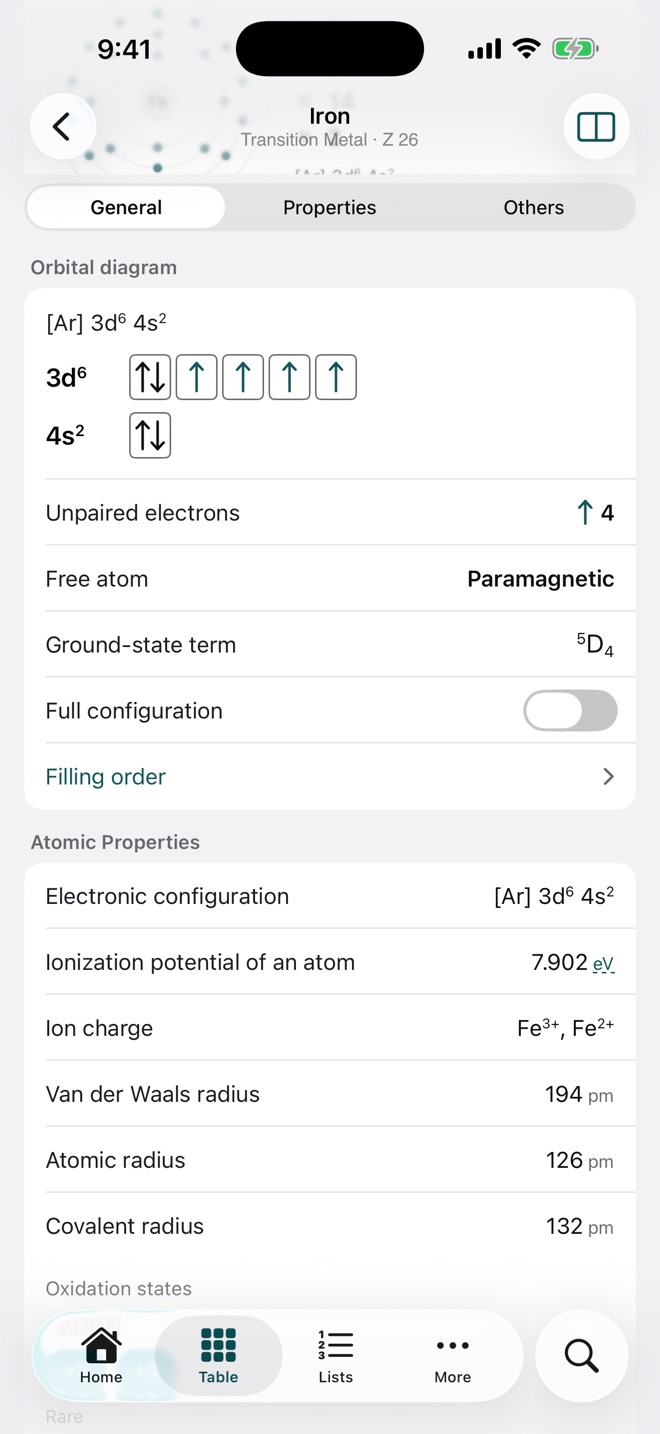
Iron orbitals
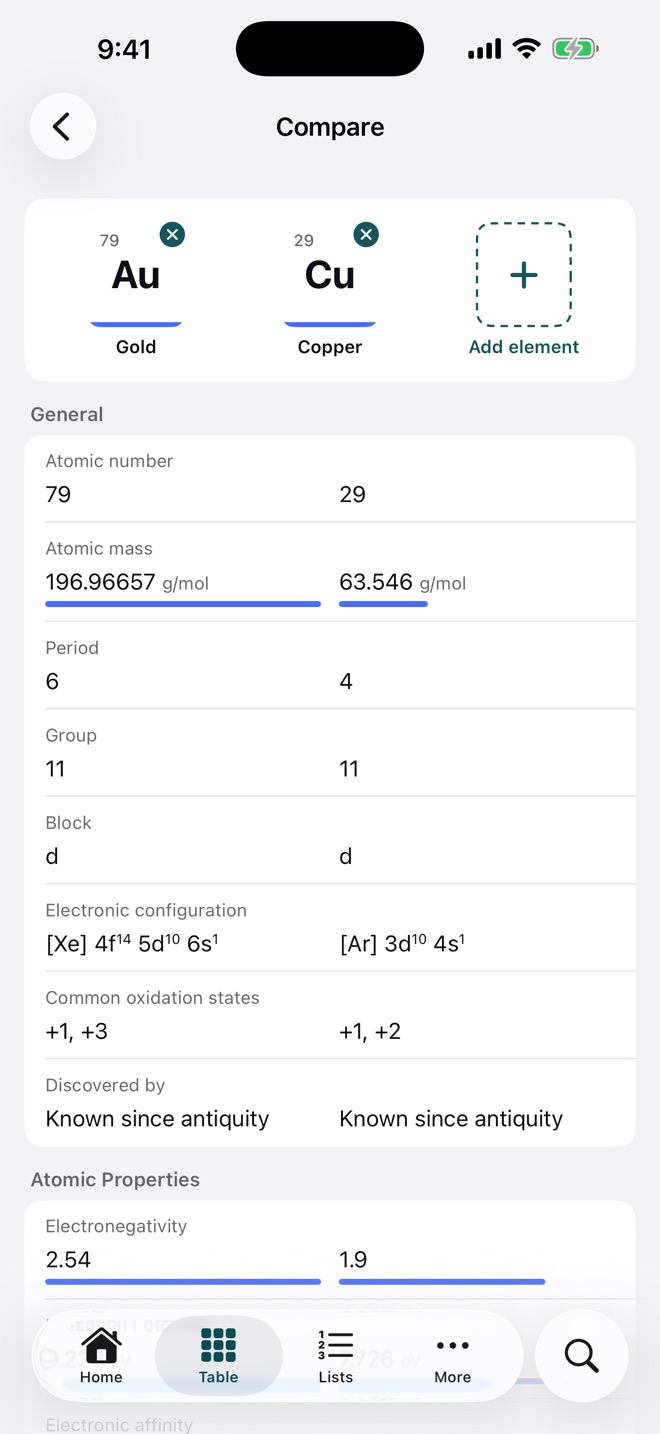
Gold versus copper
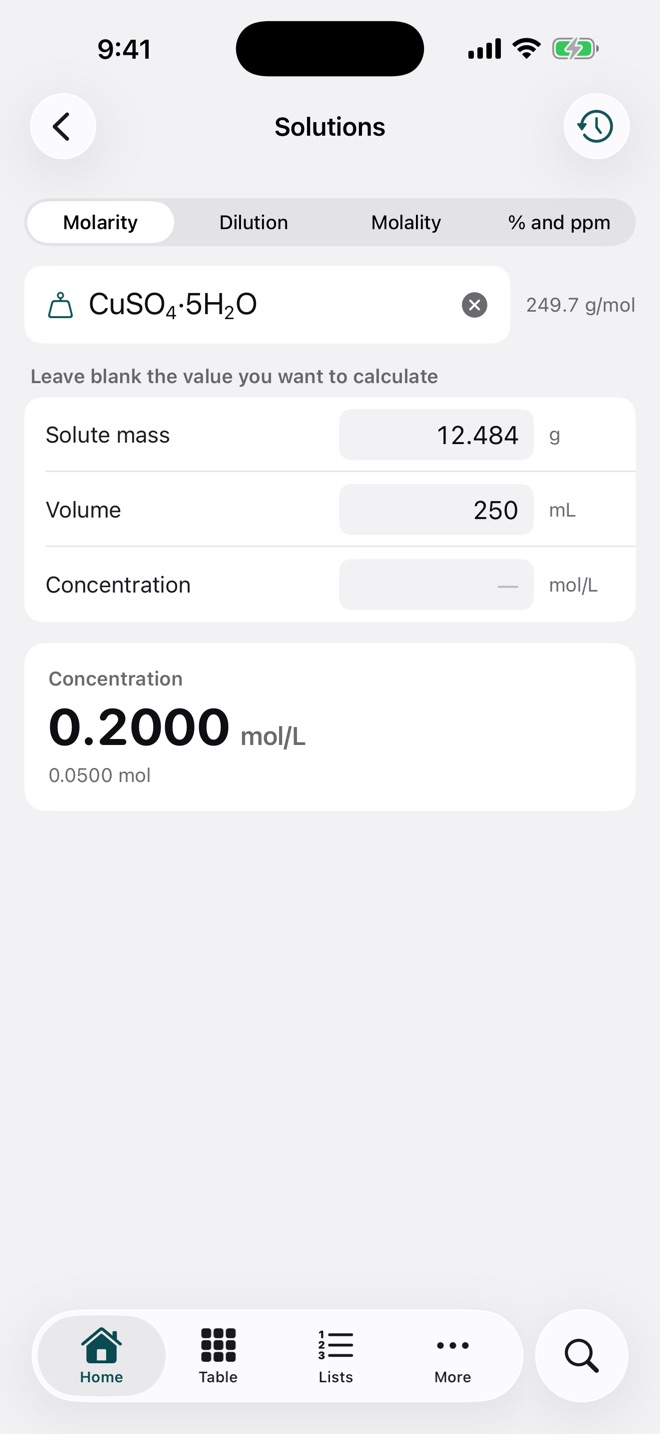
Solutions calculator
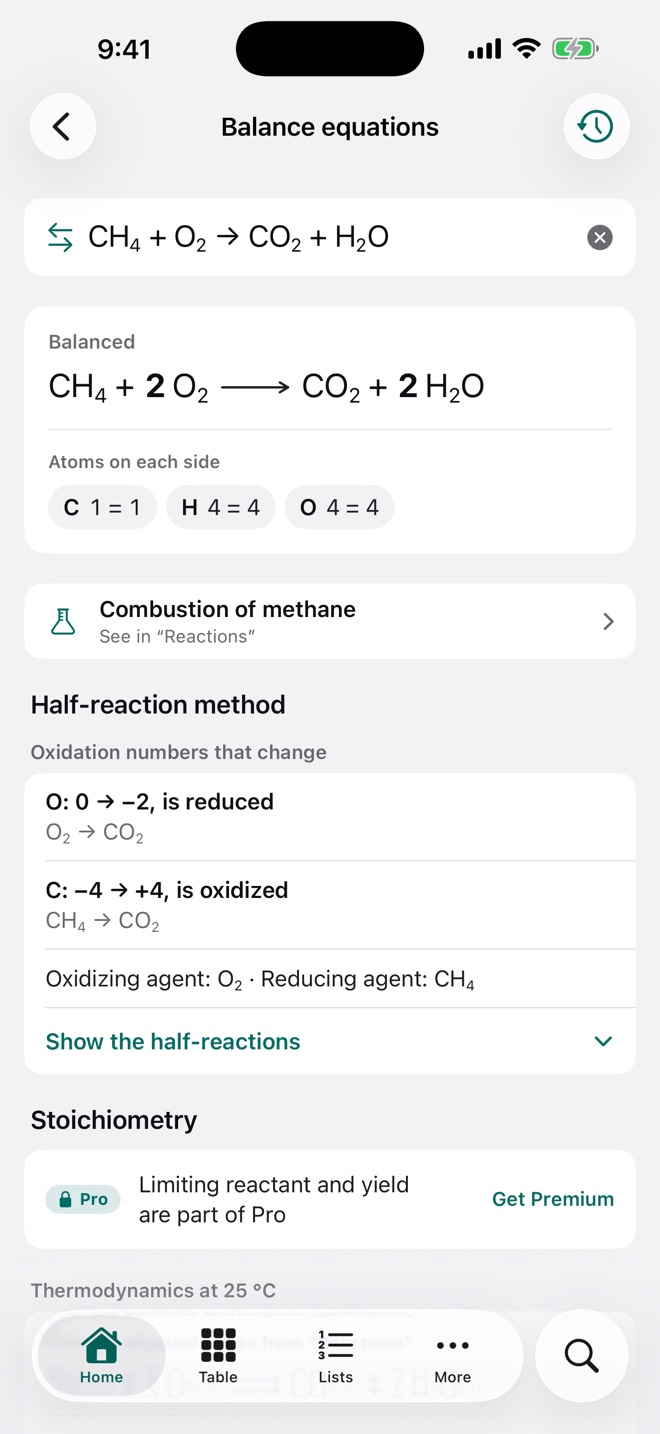
Balancing with thermodynamics
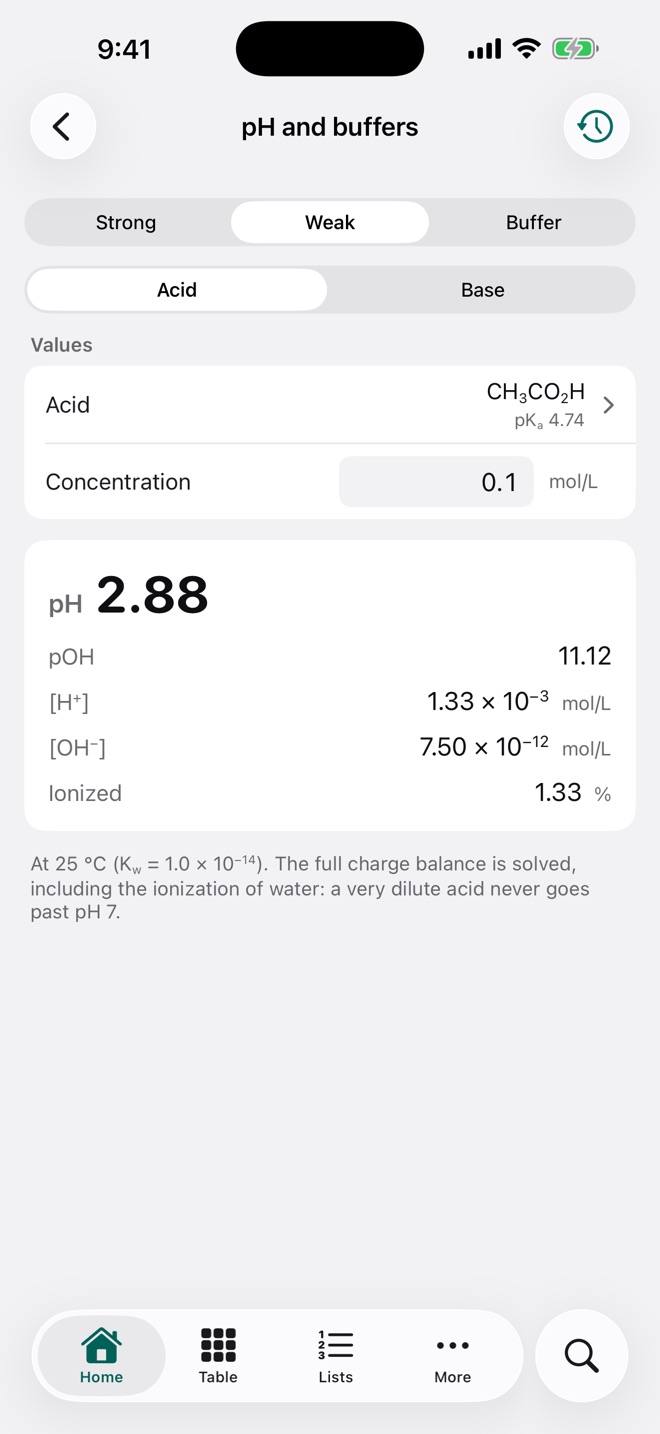
pH and buffers
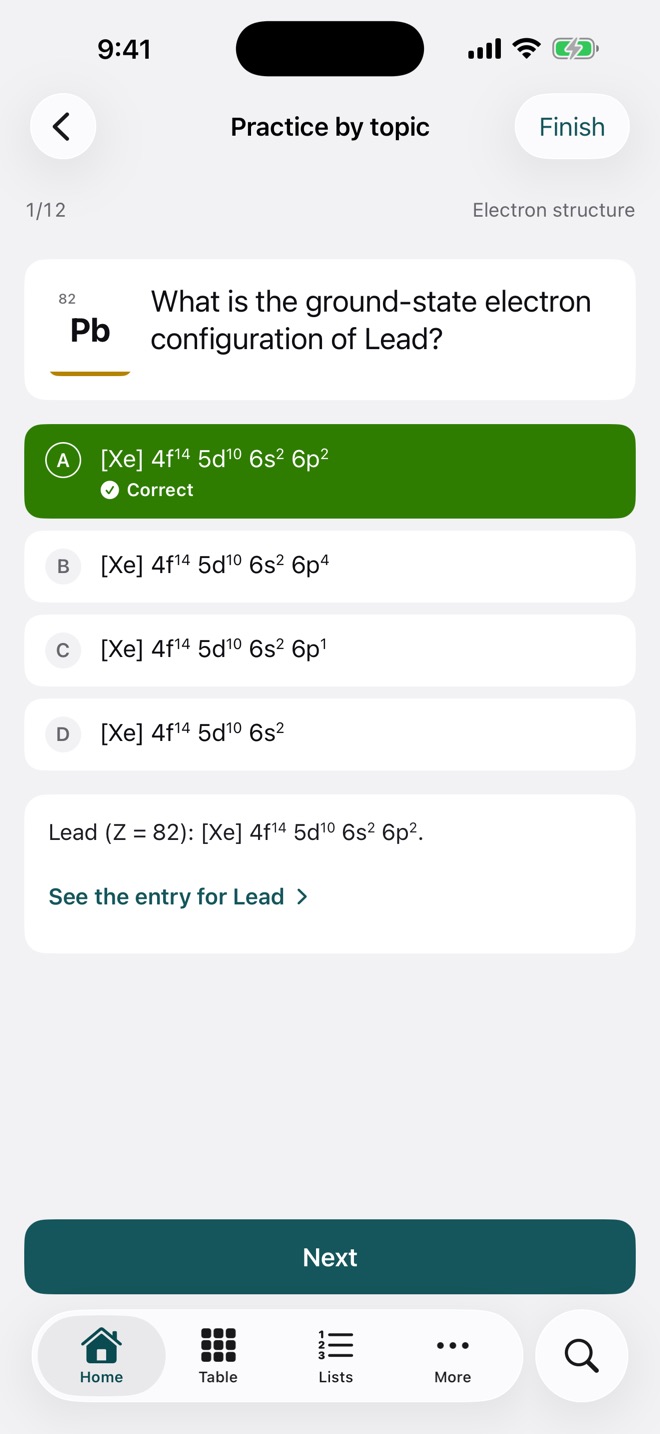
Quizzes by topic
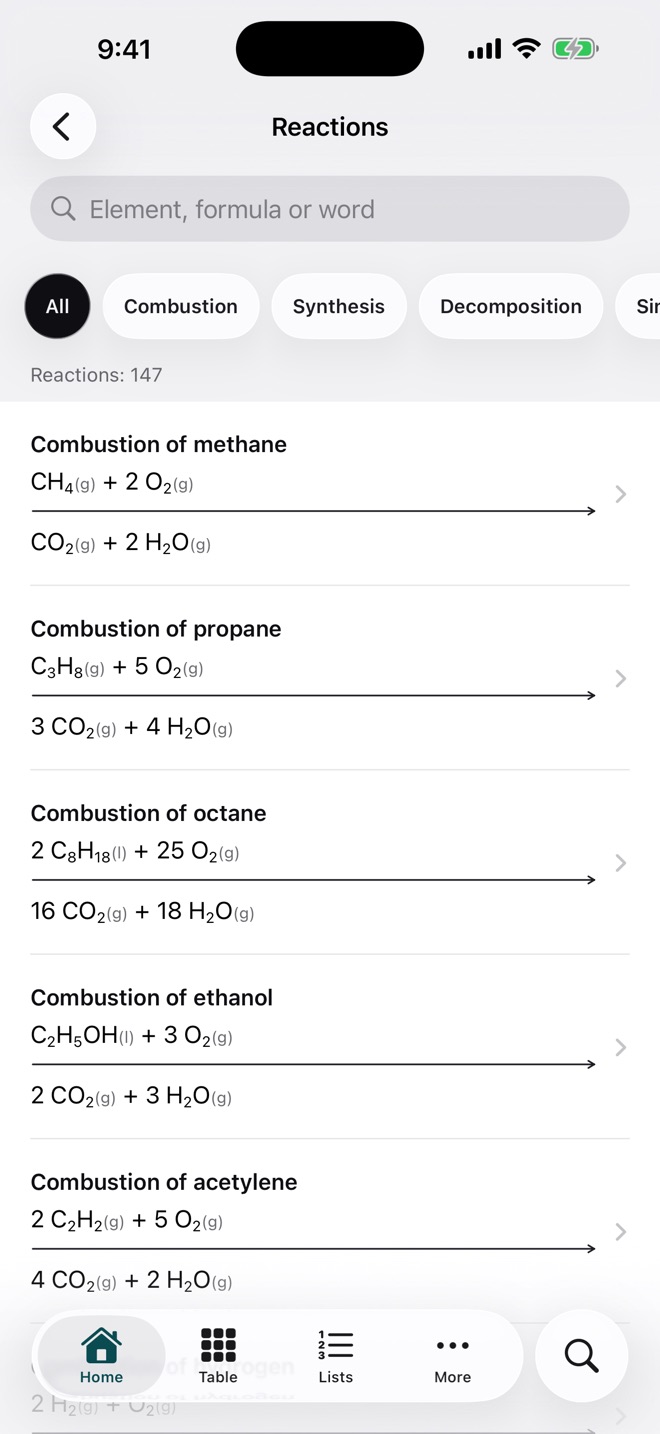
Chemical reactions
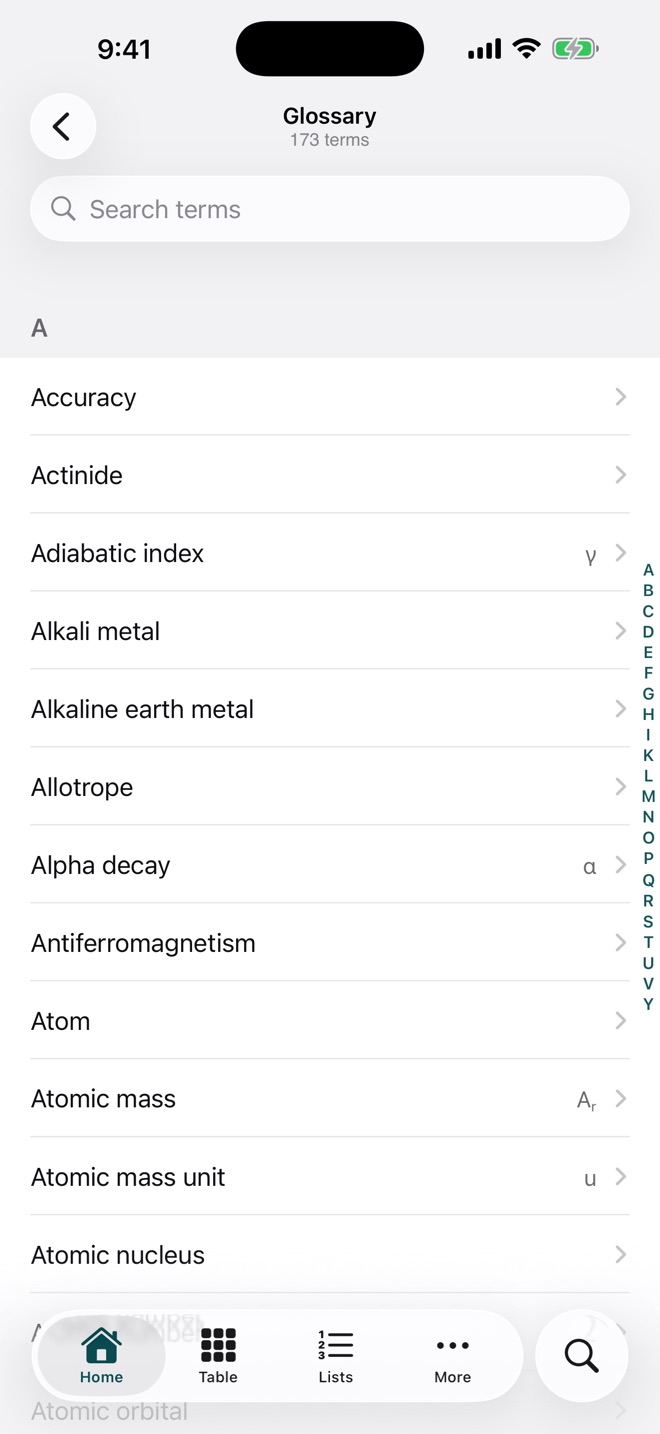
Glossary
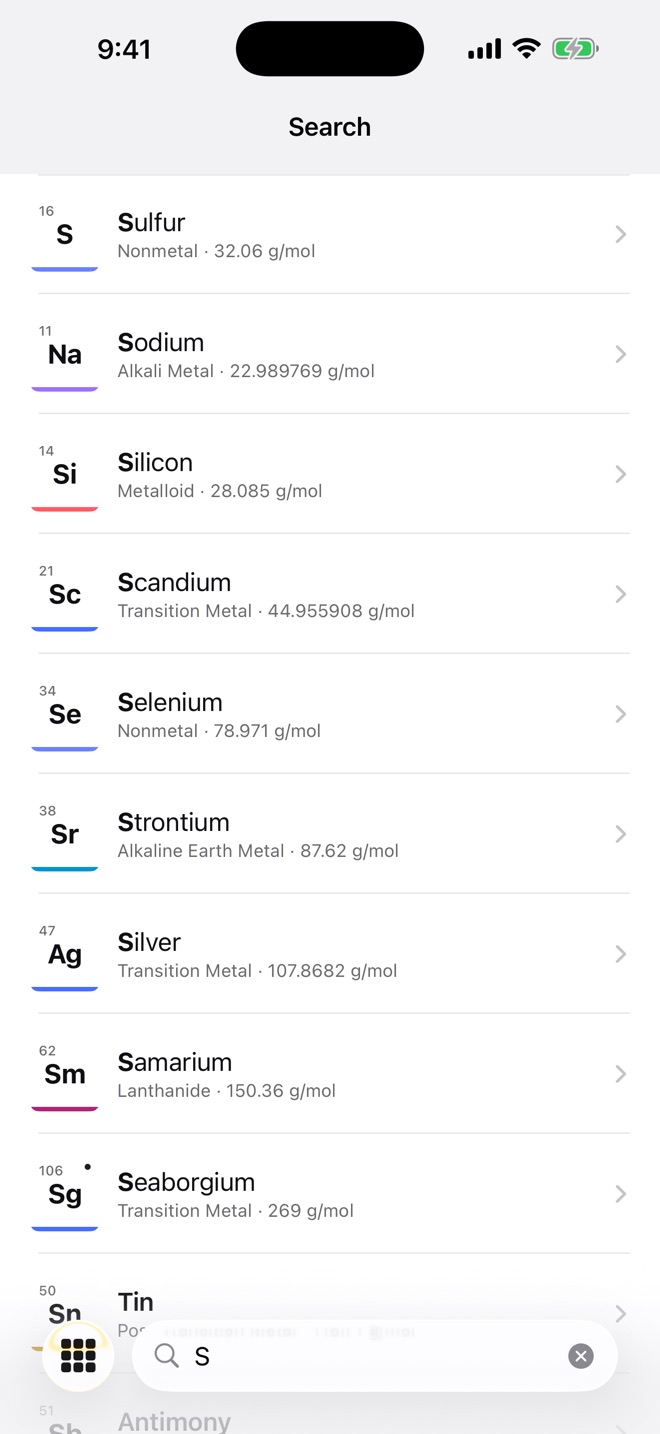
Instant search
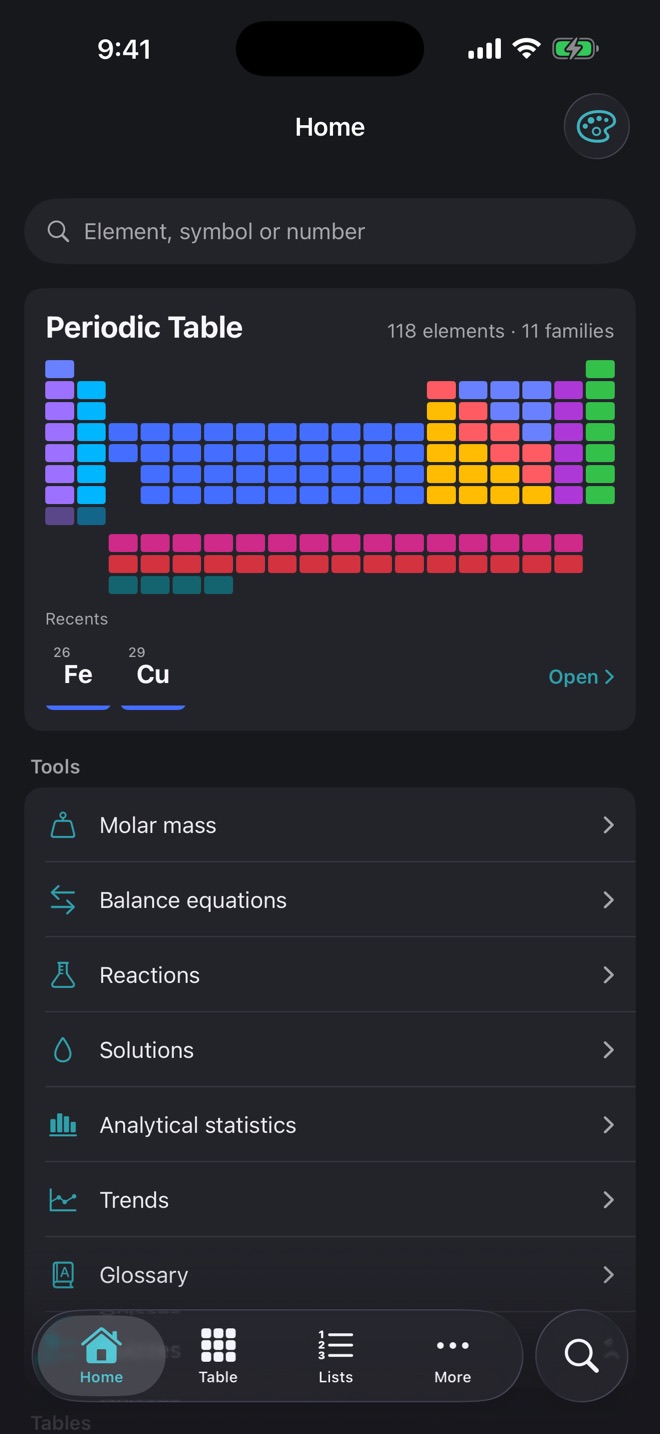
Dark mode
More room on iPad.
The same app in landscape, with the whole table, element pages and tools using every inch of the screen.
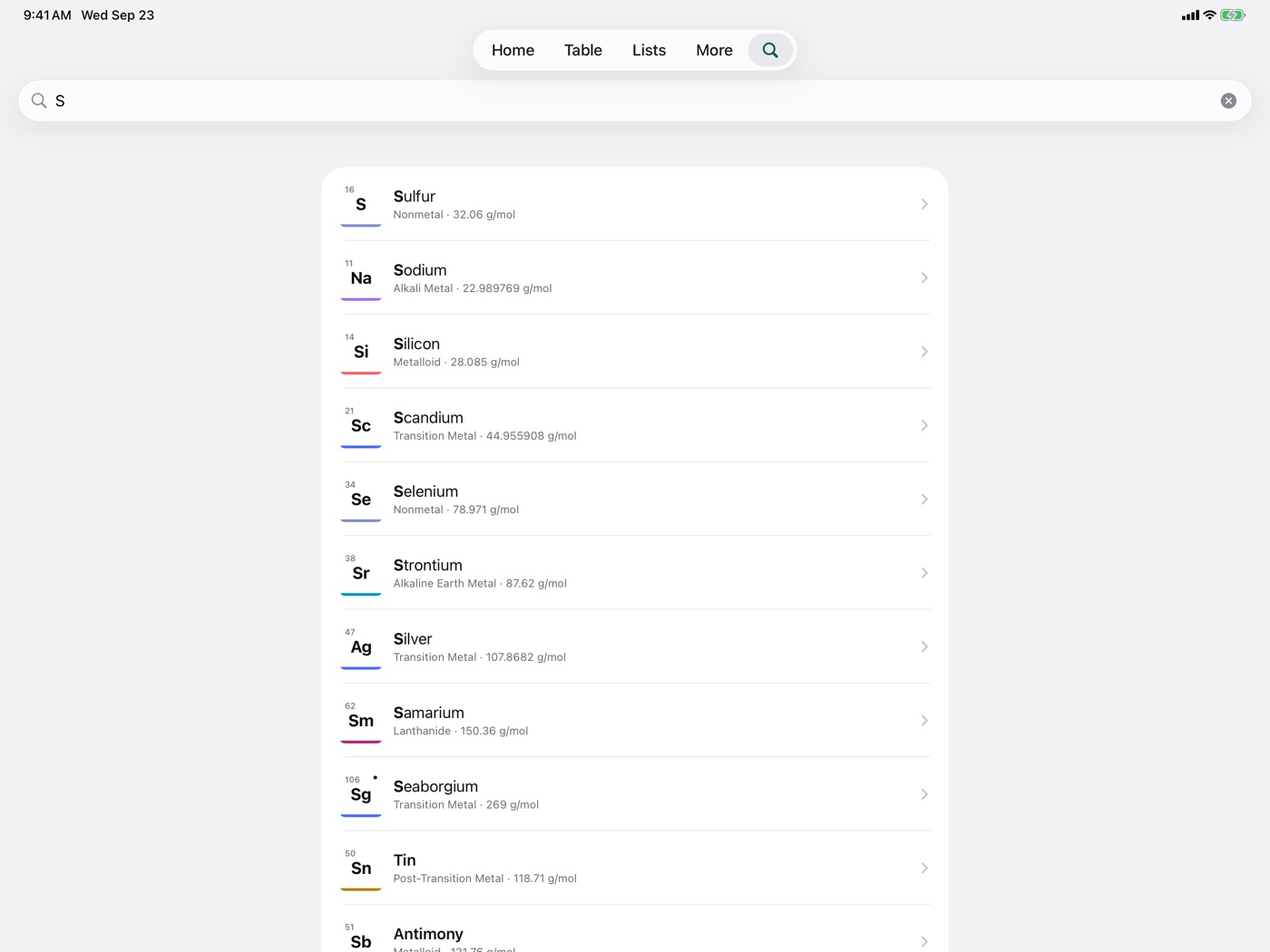
Search by symbol
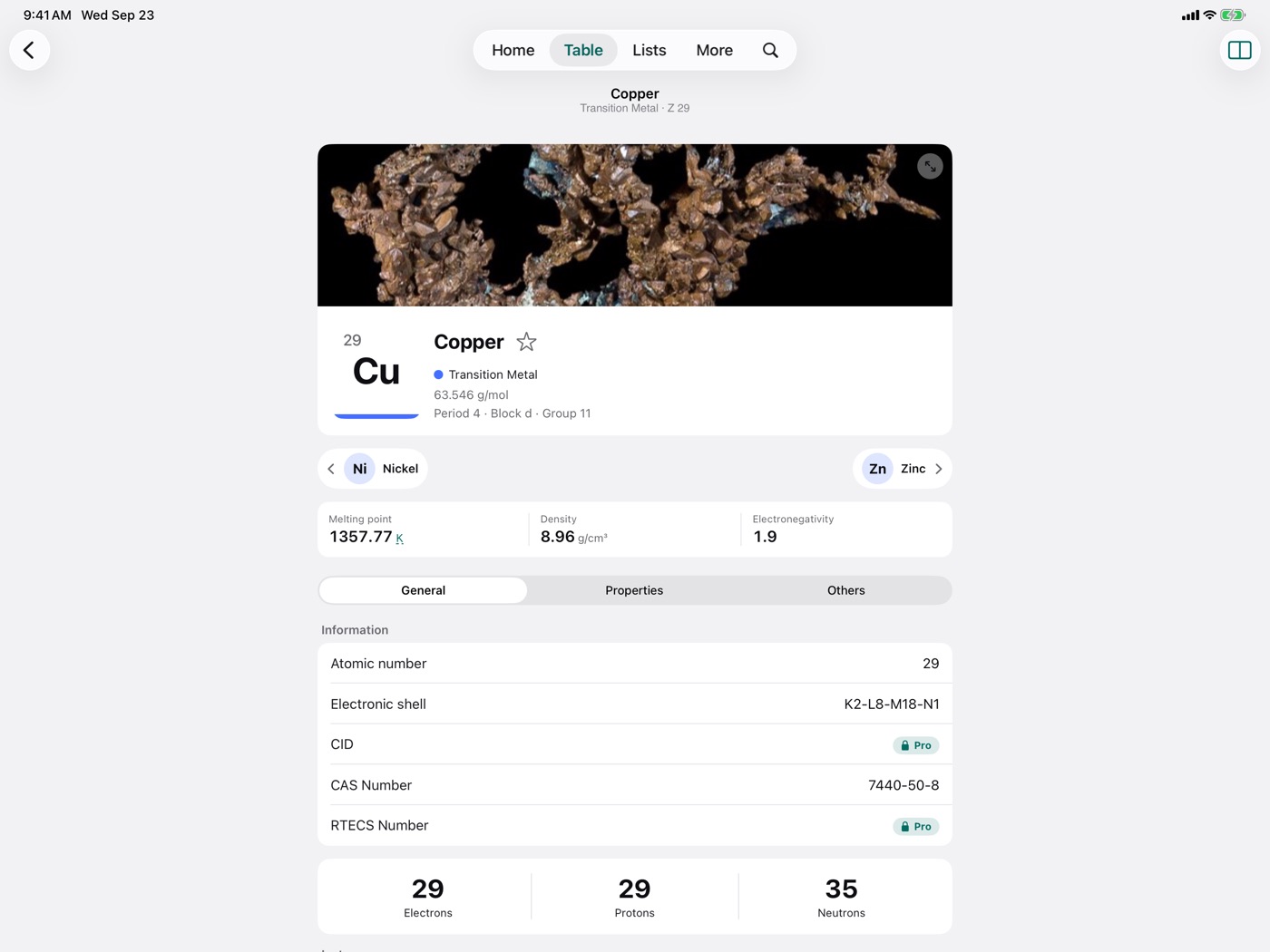
The copper page
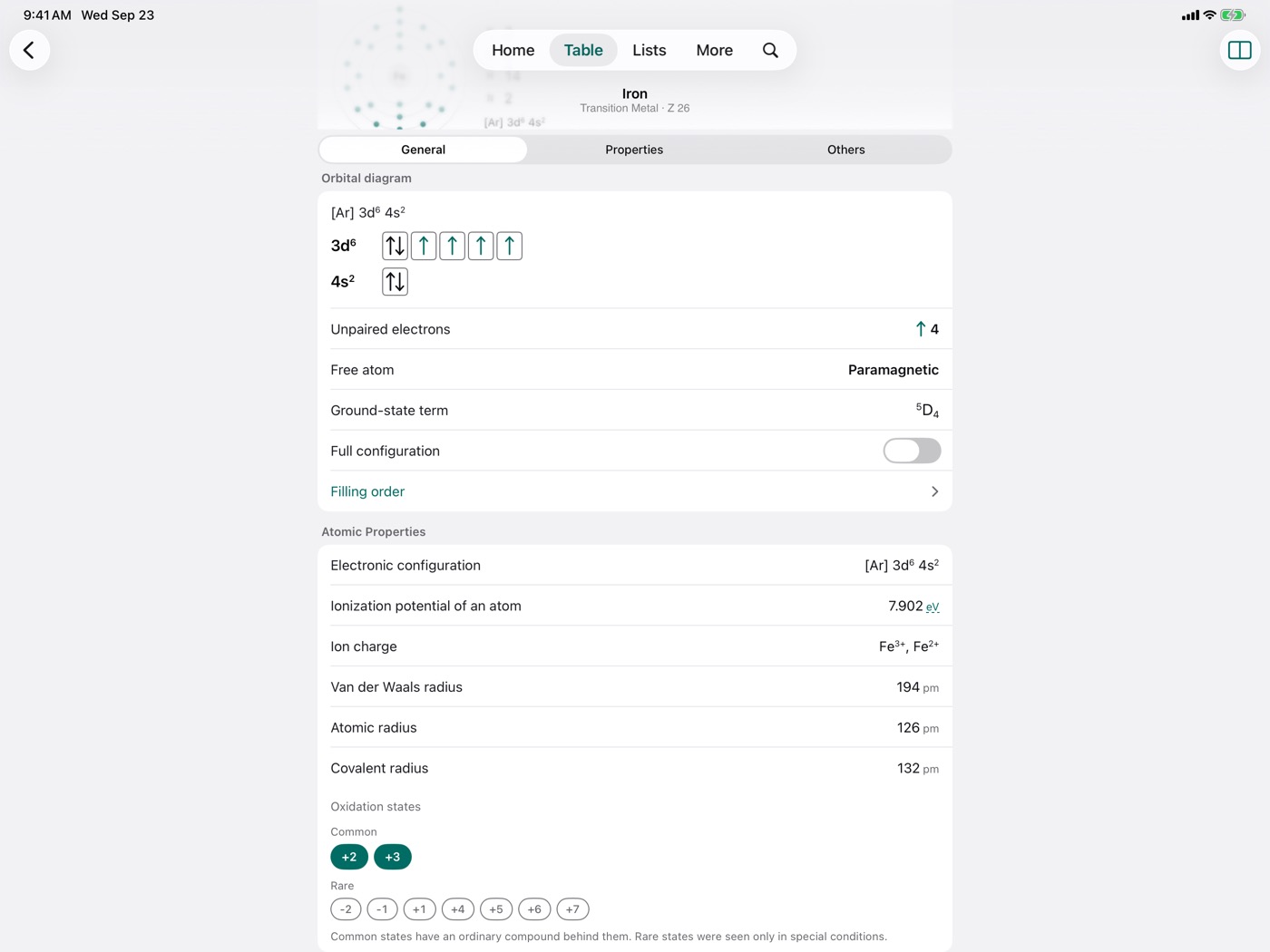
Iron orbitals and atomic properties
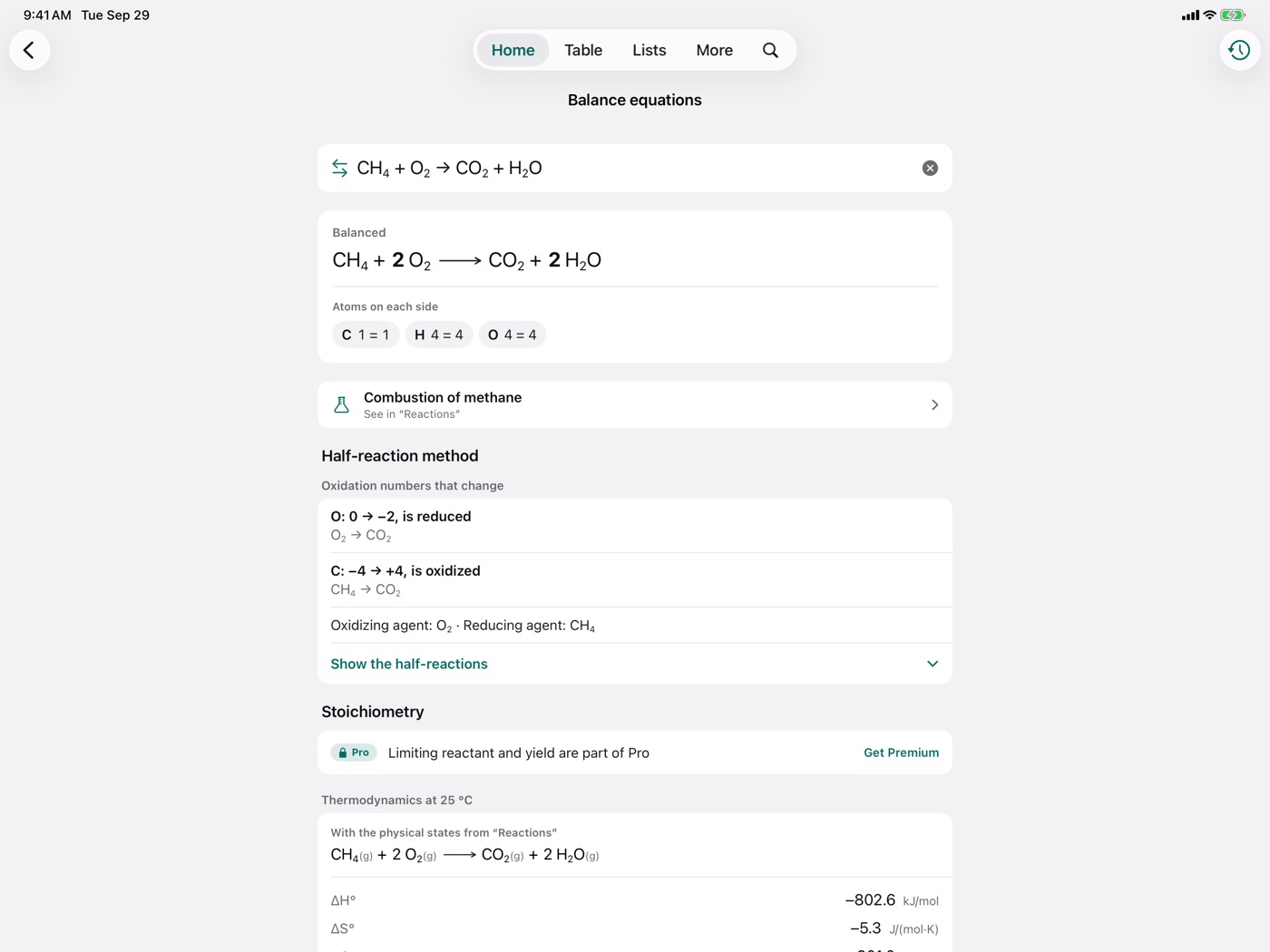
Balancing with thermodynamics
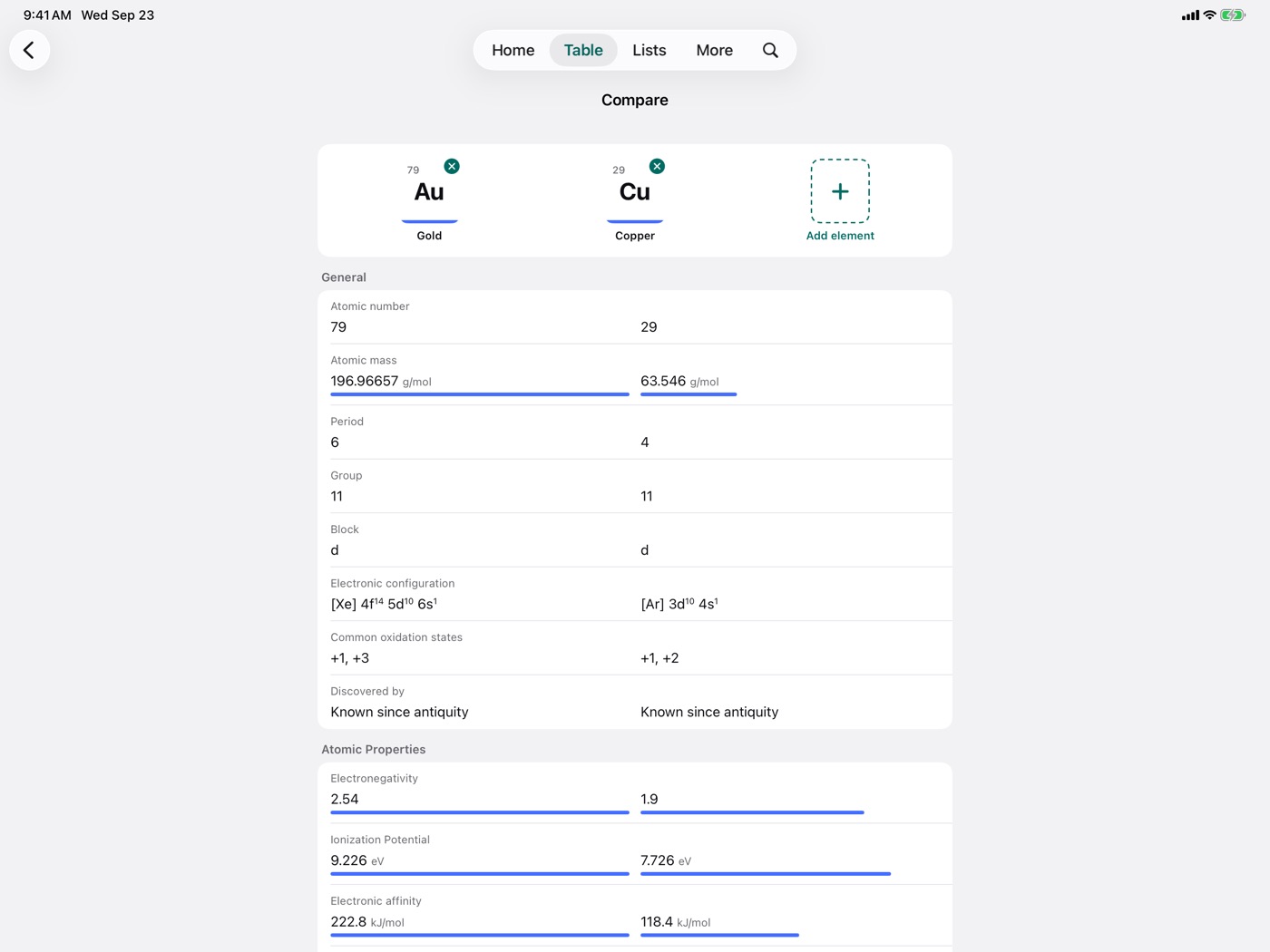
Gold versus copper
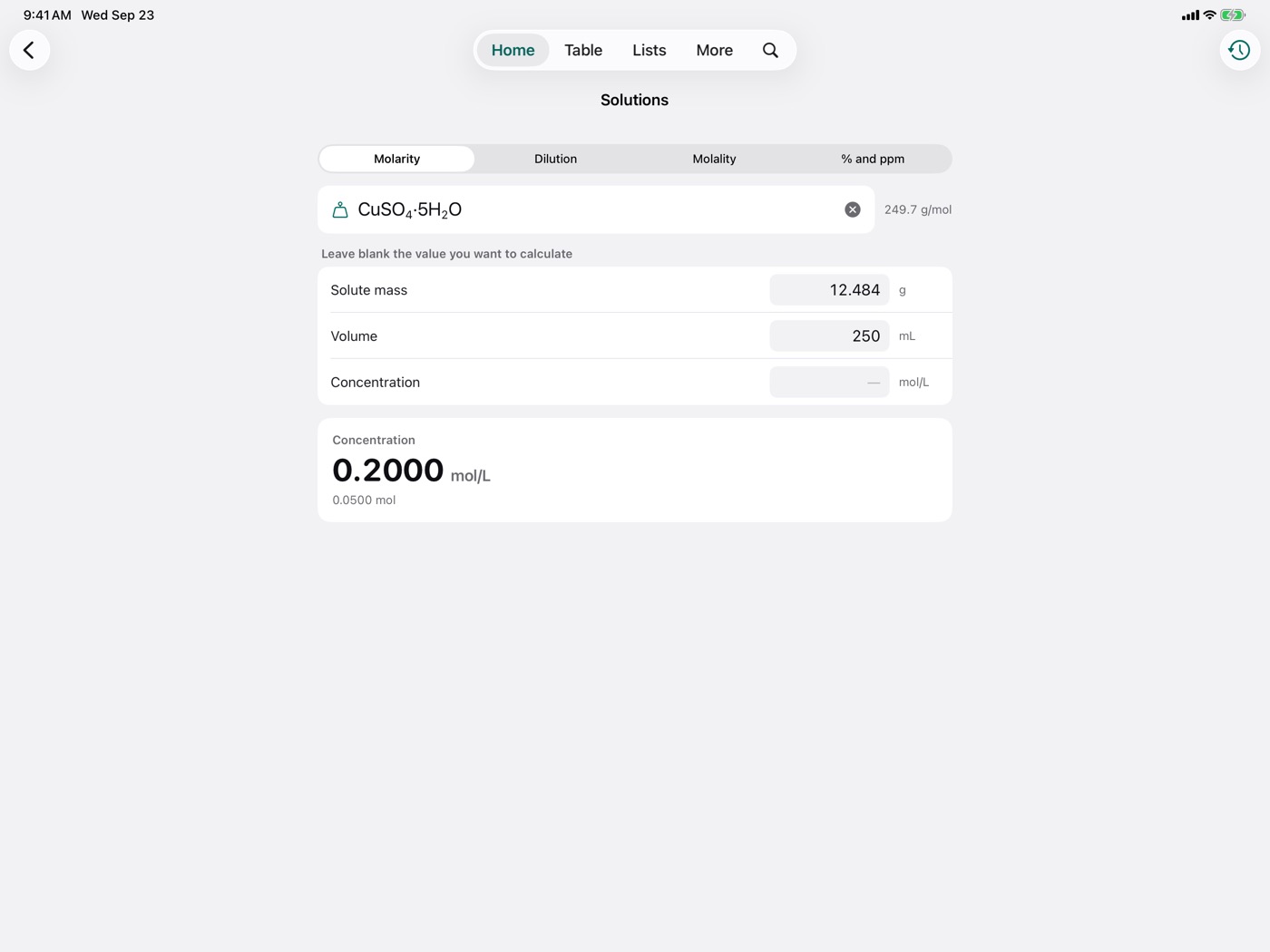
Solutions calculator
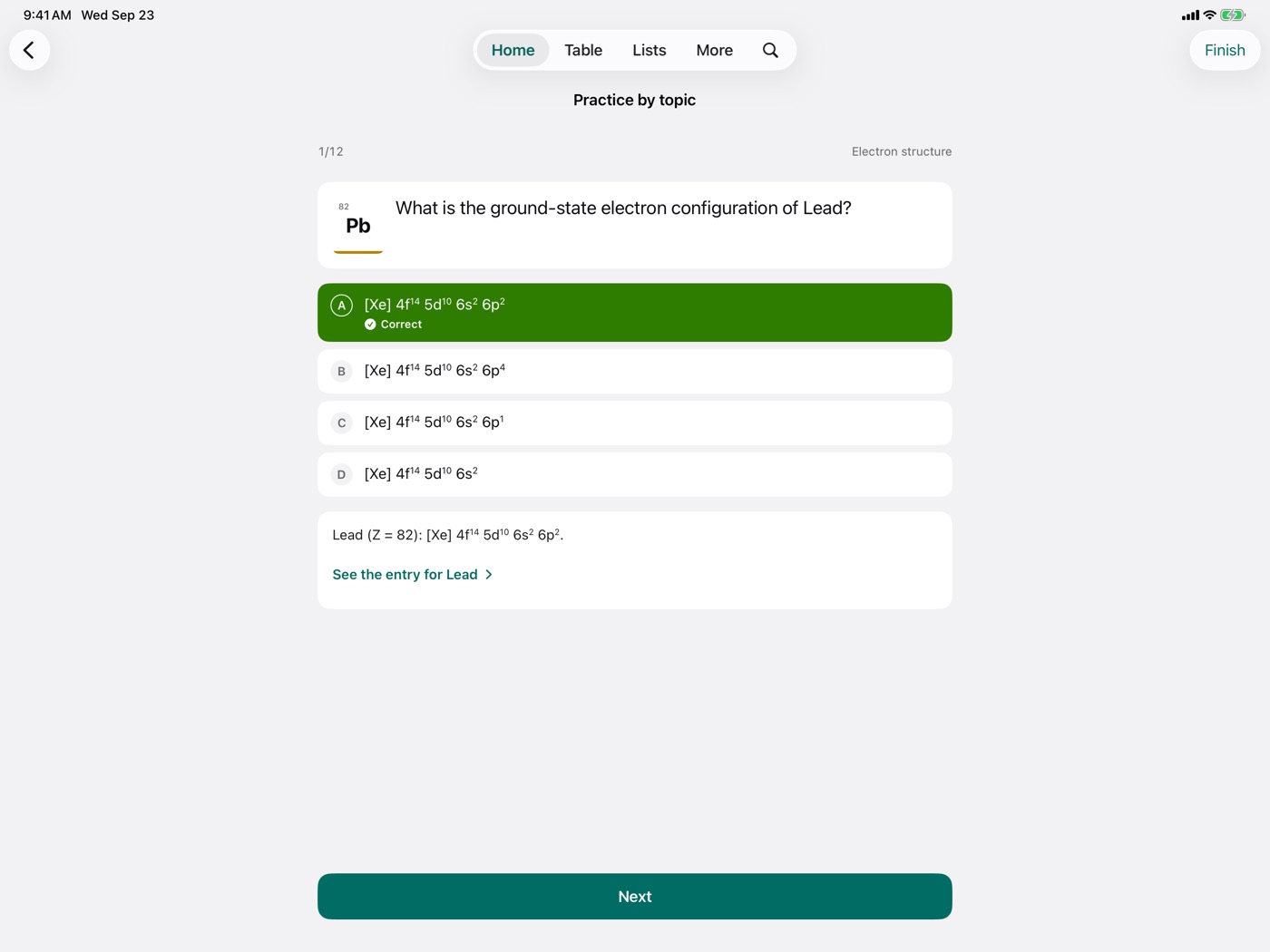
Practice by topic
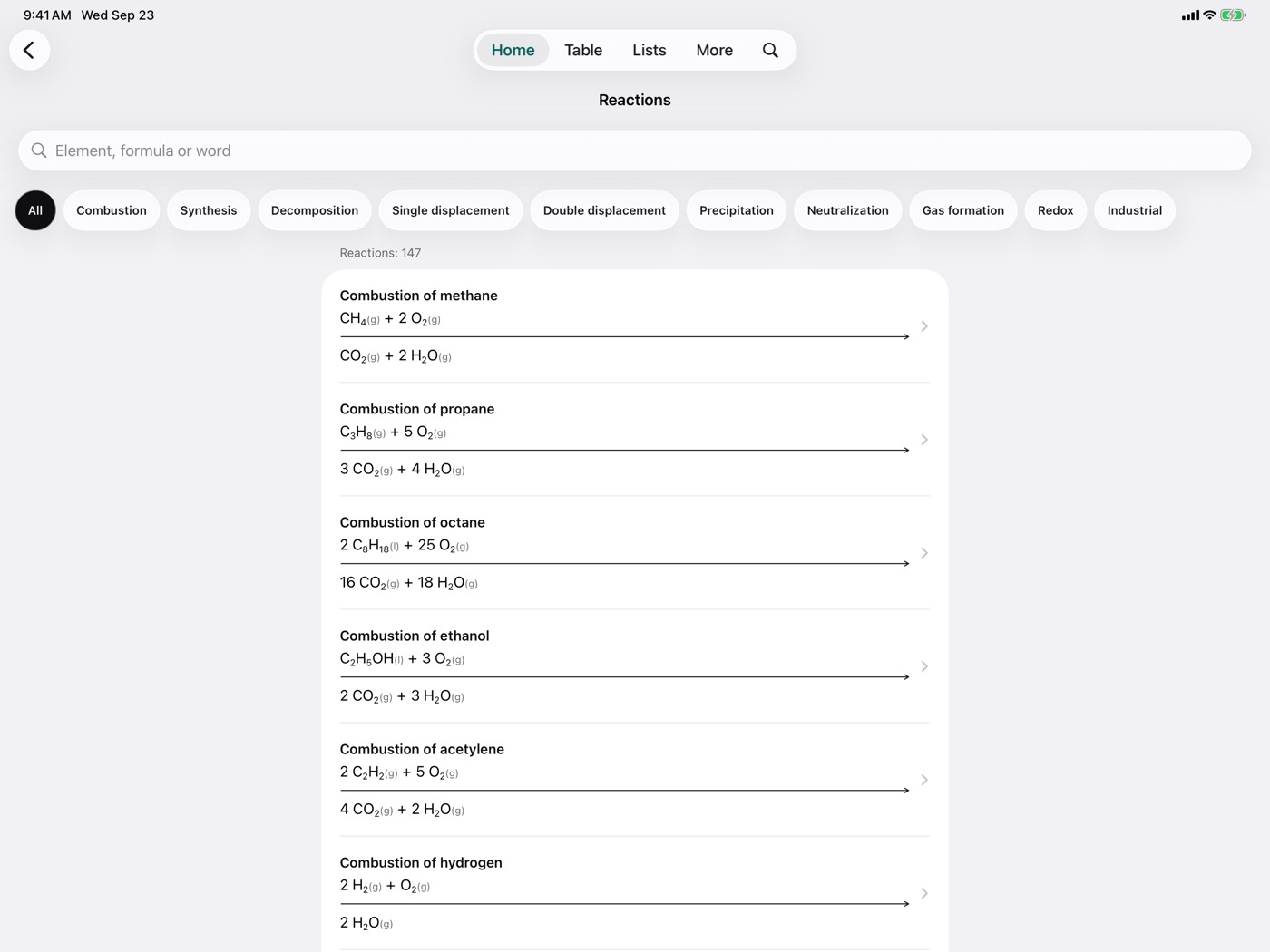
Chemical reactions
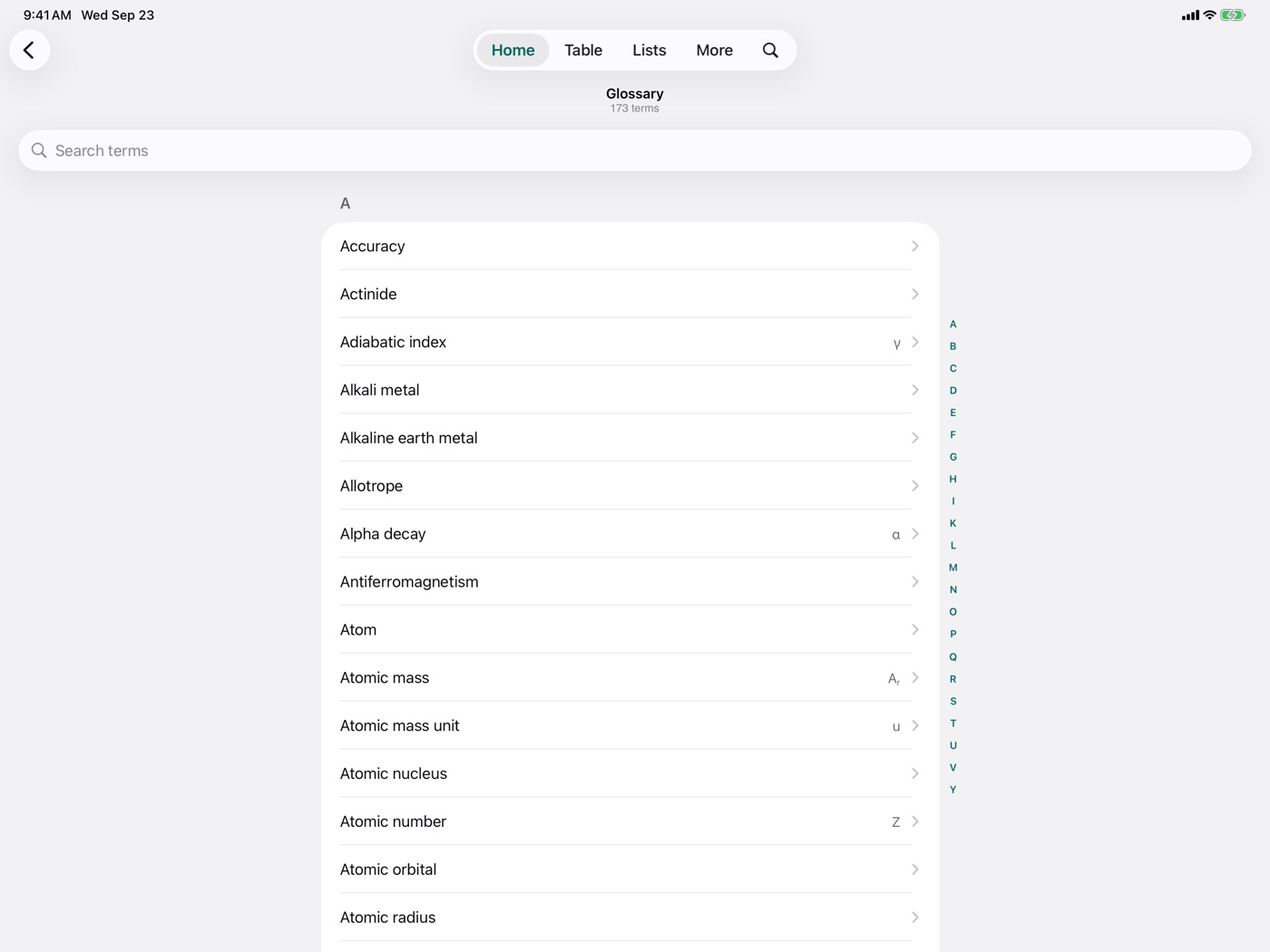
Glossary
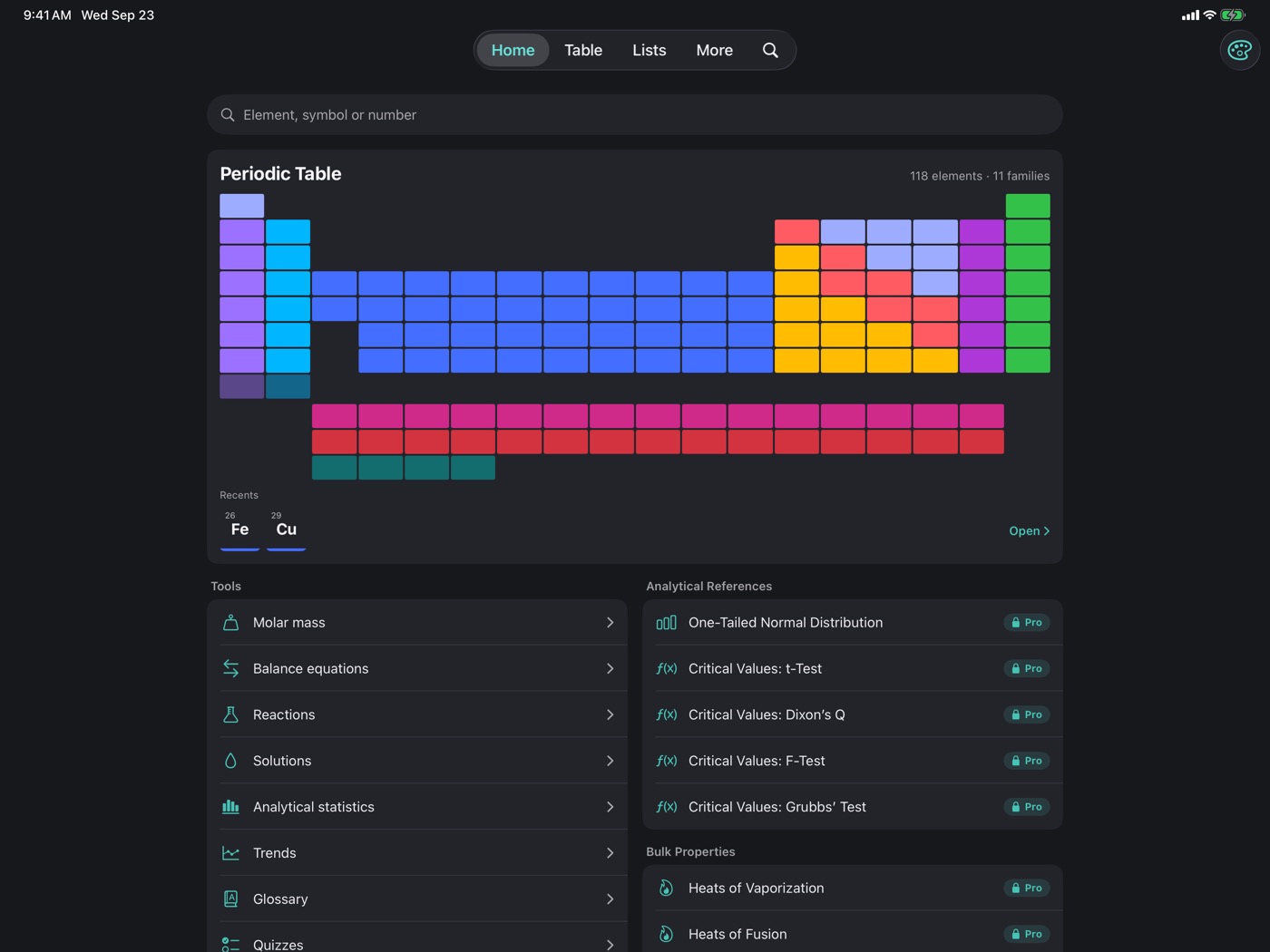
Home in dark mode
Everything you need for class.
The whole appendix of your chemistry textbook, always two taps away: from electron configuration to Student’s t.
Search the way you think
By name, symbol, atomic number, Latin or English name, CAS number or family.
A page for every element
Over 70 properties, from safety (NFPA 704) to isotopes, emission spectra and real photos of 97 elements. Touch and hold any value to copy it.
Configuration and orbitals
Orbital diagram with Hund’s rule, unpaired electrons and ground-state term. If the real configuration breaks Madelung’s rule, it tells you.
Compare and spot trends
Two or three elements side by side, 38 sortable lists, a trends chart and a heat map on the table.
Eleven lab calculators
Molar mass, empirical formula, IUPAC nomenclature, equation balancing (redox too), solutions, gases, colligative properties, equilibrium, pH, cells and statistics.
Quizzes built from the data
Eight topics and three levels. Every answer shows the value behind it, with a link to where it lives.
Reactions with thermodynamics
147 reactions with their conditions, oxidation states, and ΔH°, ΔS°, ΔG° and K at 25 °C, ready to balance in one tap. Plus a 173-term glossary.
22 reference tables
Solubility, reduction potentials, acids and bases, Ksp, thermodynamic data, ionization energies and critical values of t, F, Q and Grubbs.
Step by step: Molar mass calculator · pH calculator · Chemical equation balancer · All 118 elements
Data you can trust.
Every value is checked against public reference sources, and the sources are listed in the app itself, under More › Data sources. Take the iron page, for example:
| Atomic mass | 55.845 uPubChem · IUPAC |
|---|---|
| Electron configuration | [Ar] 3d⁶ 4s²checked against NIST |
| Electronegativity (Pauling) | 1.83PubChem · IUPAC |
| Stable isotopes | ⁵⁴Fe ⁵⁶Fe ⁵⁷Fe ⁵⁸FeIAEA · NUBASE |
And when a value doesn’t exist, the app doesn’t make one up.
- ---
Anything without a reliable measurement is shown as unknown. An honest gap beats a made-up number.
- 119–124
Hypothetical elements are clearly marked: their data are predictions, not measurements.
- Fe²⁺ Fe³⁺
Oxidation states are split into common, rare and predicted.
Free, with no ads and no data collection.
What you need every day is free. Pro is a one-time purchase that’s yours forever, no subscription; if you prefer, there are also monthly and yearly plans. All three unlock the same thing on every device with your Apple Account.
Free
For studying every day.
- The table, search and each element’s core data
- 10 reference tables and 28 lists
- All 147 reactions and the glossary
- Unlimited quiz practice
- All eleven calculators in their basic modes
- Apple Watch, widgets and three themes
Pro
One payment, forever. Or monthly or yearly.
- The other 12 tables and 10 lists
- Advanced data: magnetic and electrical properties, the critical point and every radioactive isotope
- Timed exams, spaced review and stats
- Advanced calculator modes: stoichiometry, gas mixtures, buffers, the Nernst equation, confidence intervals and outlier tests
- PDF export and ten more themes
Used it back in 2019? It’s back, rebuilt from scratch, and if you bought Premium it’s still yours: it comes back when you open the app or under More › Restore purchases.
What you save stays on your device.
- No accounts or sign-up
- No ads or tracking
- No third-party analytics
- Suitable for students of any age
Made for your Apple devices.
A native app on every screen, using the system features you already know.
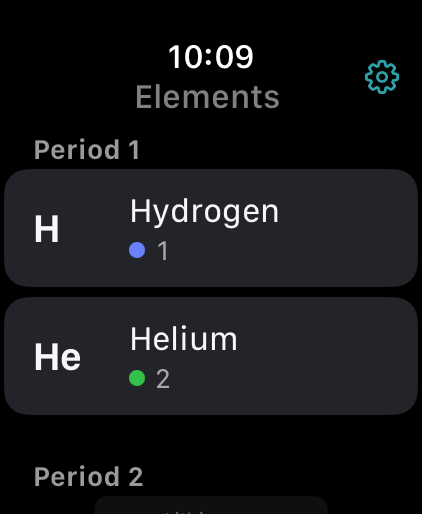
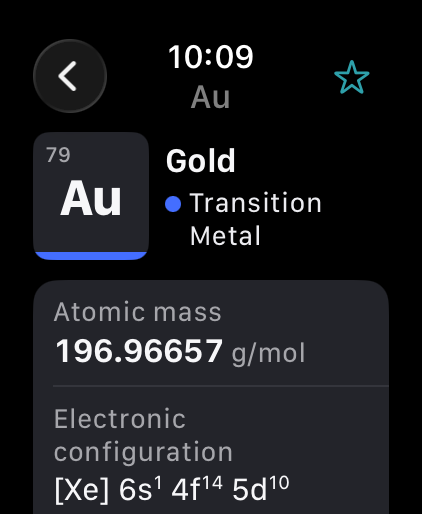
- Apple Watch
- All 124 elements on your wrist, independent of your iPhone.
- Widgets
- Element of the day, also on the Lock Screen, plus your favorites.
- Siri, Shortcuts and Spotlight
- “Molar mass in Periodic Table”, or find an element from system search.
- Your units
- Kelvin or Celsius, kJ/mol or eV, and MPa, bar or atm.
- Thirteen themes
- Named after scientists. Lavoisier, Curie and Dalton, designed for color blindness, are free.
- Accessible
- VoiceOver, larger text, Dark Mode and a shape for each family if you can’t tell the colors apart. 20 languages.
Questions.
- Is Periodic Table free?
- Yes. The app is free to download, with no ads. The table, every element’s core data, 10 reference tables, 28 lists, all 147 reactions, the glossary, quiz practice and all eleven calculators in their basic modes are free. Pro is optional: a one-time purchase, or a monthly or yearly plan.
- Does it work offline?
- Yes. All the data lives inside the app, so it works in class, in the lab or in airplane mode. You only need a connection to buy or restore Pro and to open external links.
- Where does the data come from?
- Element data is checked against PubChem (NIH) and IUPAC, electron configurations against the NIST Atomic Spectra Database, and isotopes against the IAEA (NUBASE and AME). A value with no reliable published measurement is shown as unknown (---), never made up.
- Which devices does it run on?
- iPhone and iPad with iOS 16 or later, Mac with Apple silicon, and Apple Watch, with its own app that works without your iPhone.
- Which chemistry calculators does it include?
- Eleven: molar mass and composition, empirical formula, inorganic and organic nomenclature (IUPAC), equation balancing (redox too) with ΔH°, ΔS°, ΔG° and K, solutions, gases, colligative properties, chemical equilibrium with ICE tables, pH and buffers, electrochemical cells and analytical statistics.
- Does the app collect any data?
- No. There are no accounts, ads, trackers or analytics. Your favorites, notes and progress stay on your device.

Start studying with data you can trust.
Free on the App Store for iPhone, iPad, Mac and Apple Watch.